
Wilkinson County Arrest Records and Court Charges
An arrest record is the record of the arrest itself: the agency that made it, the date, and the booking that follows. In Wilkinson County, arrests are made by the Sheriff's Department under Sheriff Reginald L. Jackson, whose office sits at 1389 US Highway 61 South in Woodville, away from the courthouse on Main Street. The court charge record begins later, when a prosecutor decides which formal charges to file with the court. An arrest does not by itself create a court charge, because a prosecutor reviews the case and chooses what, if anything, to file.
The Sheriff's official page describes the office's law-enforcement and jail duties, including keeping a jail docket. A look at the office and its contact details is on the Wilkinson County Sheriff page.
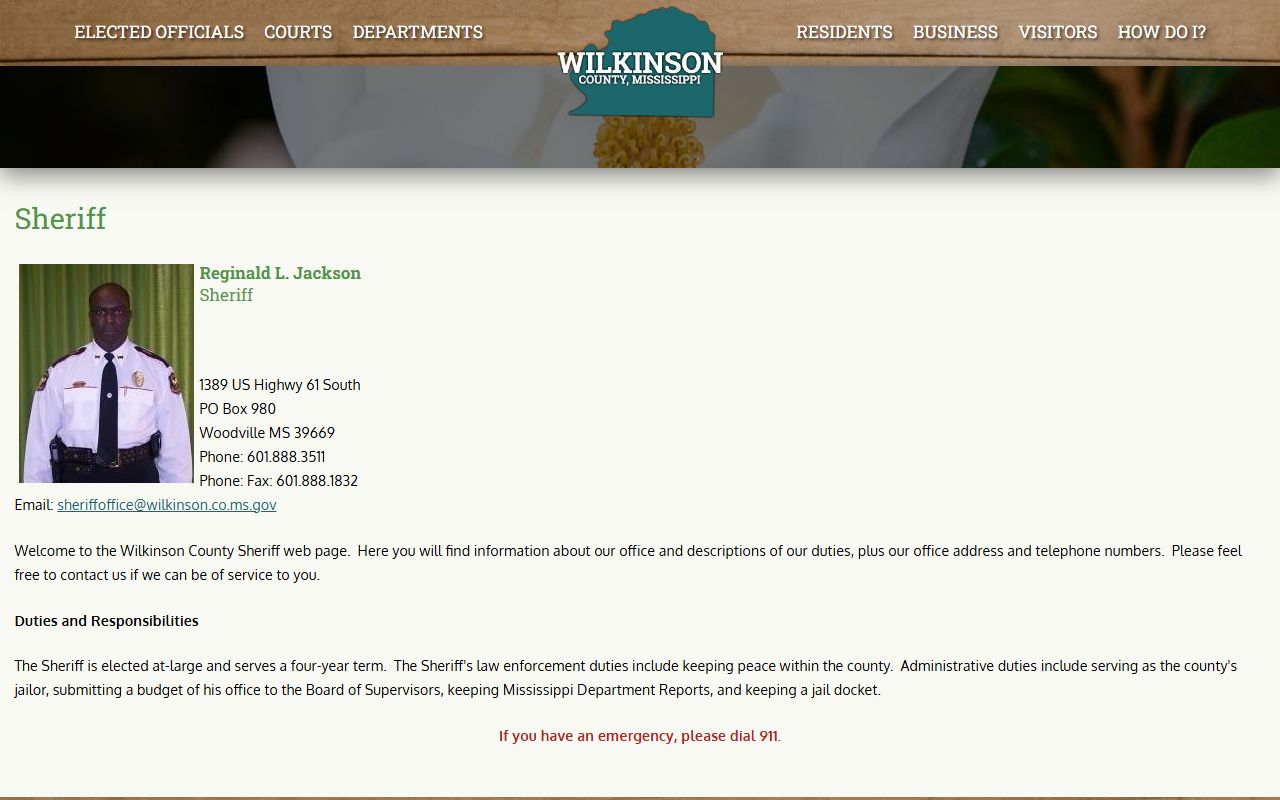
That sheriff and jail side is the booking record. The court charges after arrest are a different file, opened by the prosecutor and tracked through the case. The booking and custody detail belongs to the jail roster, covered on the Wilkinson County inmate records page, while the full case file and final outcome live with the Circuit Court.
Wilkinson County Arrest Records vs. the Court Charge Record
Treating an arrest record and a charge record as the same thing leads to confusion. They come from different offices, cover different events, and update on different schedules. The terms below mark the dividing line.
- Arrest record
- The law-enforcement record that a person was taken into custody, created by the Sheriff's Department at booking.
- Court charge record
- The formal charges a prosecutor files with the court, which become part of the case file.
- Booking
- The intake process at the jail after an arrest, where custody information is logged.
- Affidavit
- A sworn statement that, in Justice Court, can begin a felony matter after arrest.
- Charging document
- The filing that opens the court charge record, such as a complaint, information, or indictment.
For account services tied to the local jail, the vendor lists a facility page for Wilkinson County, which is part of the custody and booking side rather than the court charge record. The ConnectNetwork Wilkinson County jail facility page shows that vendor account setup.
The jail-side services and roster detail belong with inmate records. The charges a prosecutor files are what this record is built around.
How to Find Wilkinson County Arrest Records and Charges
There is no county-built online charge lookup for Wilkinson County. Charges and their status appear in the court case file, reached through the Mississippi Electronic Courts system using PAMEC, or at the clerk counter. The Sixth Circuit Court District went live on the electronic system on March 31, 2025, so felony charge entries from that date forward are more likely to be searchable online, while booking detail stays with the Sheriff and the jail.
- Start with the right office. The court charge record runs through the Circuit Clerk and the Sixth Circuit MEC path for felonies, and through Justice Court for misdemeanors, DUIs, and first appearances after a felony arrest.
- For electronic files, register with PAMEC and open the Sixth Circuit Court District, then sign in with a username and password to reach case detail.
- Search by defendant name or case number and open the matching case to read the charge list.
- Check each charge for its statute code, severity level, and current status, since charges can change after they are first filed.
When the record is older, sealed-adjacent, or not online, the clerk is the dependable channel. The Circuit Clerk can be reached at 601-888-6697 for felony files, and Justice Court at 601-888-3538 for lower-court charges and first appearances. Booking and custody questions go to the Sheriff's Office at 601-888-3511, not to the courthouse. The Mississippi Public Records Act backs access to public court records, but a request for a case file should be directed to the clerk who actually holds it rather than filed blindly with the county.
How Charges Get Filed After a Wilkinson County Arrest
After an arrest, the court charge record begins with a charging document. In Wilkinson County, a felony is first heard in Justice Court for an initial appearance and the filing of an affidavit, and Justice Court judges hold sessions at the jail three times each week so each person sees a judge within three days of arrest. Serious felonies then move forward by grand-jury indictment. The three charging routes below open the case.
| Complaint / Affidavit | Information | Indictment | |
|---|---|---|---|
| Filed By | Officer or prosecutor | Prosecutor | Grand jury |
| Common For | Misdemeanors and first appearances | Some felonies | Serious felonies |
| Where in Wilkinson County | Justice Court | Circuit Court | Circuit Court |
| Starts | The early case | The case | The felony case |
Two prosecuting offices decide and file these charges. The Sixth Circuit District Attorney, Tim Cotton, prosecutes felony, misdemeanor, and juvenile cases that occur in the county and presents serious matters to the grand jury. The County Prosecuting Attorney, David Shep Crawford, represents the state in felony matters before Justice Court and in appeals from Justice Court to Circuit Court.
Charge Codes and Severity Levels in Wilkinson County
Each charge in the record is tied to a specific statute, and the statute sets the severity level. Mississippi sorts offenses into felonies, which carry the most serious penalties, misdemeanors, and lesser violations. The level controls which court hears the matter, which is why a felony lands in Circuit Court while a misdemeanor stays in Justice Court.
A single arrest often produces several separate charges rather than one. Each charge moves through the case on its own, so one count can be dismissed while another goes to trial. Reading a charge record means looking at every count and its individual status, not just the lead offense. The severity level also shapes the timeline: a felony arrest passes through a Justice Court first appearance before any grand-jury review, while a misdemeanor can resolve entirely at the lower court without ever reaching Circuit Court.
Important: One arrest can become several distinct charges, and each charge carries its own statute code, severity level, and outcome in the record.
Wilkinson County Charge Status and What It Means
Charges rarely stay frozen from filing to disposition. They can be amended, reduced, added, dropped, or dismissed as a case develops, and the docket records each change. The status terms below reflect the flags used in the Sixth Circuit case system.
| Status | What It Means |
|---|---|
| Pending | The charge is active and the case has not resolved it yet. |
| Amended / Reduced | The charge was changed, often to a lesser offense, before disposition. |
| Dismissed | The charge was dropped by the court and no conviction follows. |
| Nolle Prosequi | The prosecutor chose not to pursue the charge, ending it without a conviction. |
| Bound Over | A lower-court charge was sent up toward Circuit Court for felony handling. |
Note: A dropped or dismissed charge can still appear in the record even though it did not lead to a conviction.
Statewide Charge and Criminal History Lookups
Some charge information rolls up into statewide systems rather than a single county file. Charges and convictions that involve state custody appear in Mississippi Department of Corrections records, which is the route for people sentenced to state prison or supervision. The MDOC inmate search runs on either a name or an MDOC ID number, and it covers people in state custody rather than those held locally before trial. County booking detail, by contrast, stays with the Sheriff and the jail.
A separate statewide tool covers registered offenders. The Mississippi Department of Public Safety publishes a public sex offender registry that is searchable across the state. The Mississippi DPS sex offender registry is one of the few charge-related lookups that is openly searchable without an account.
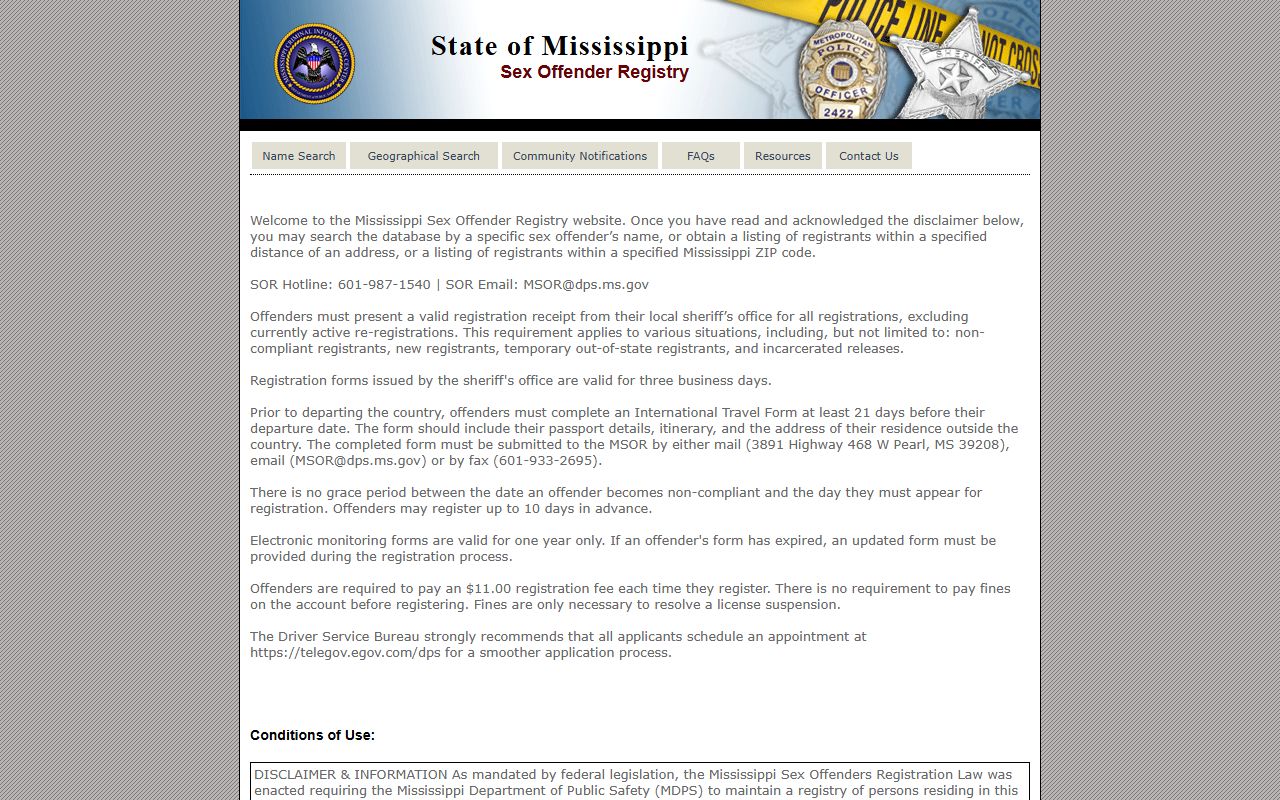
These statewide systems do not replace the county charge record. For the full case file, the charges as filed, and the final disposition, the Wilkinson County criminal court records held by the Circuit Clerk remain the primary source.
Charge vs. Conviction
A charge is an accusation, not a finding of guilt. Filing a charge requires only probable cause, while a conviction requires a plea or a verdict under a much higher standard. A charge record can show counts that were later reduced, dismissed, or ended without a conviction, so the presence of a charge says nothing about the final outcome.
| Charge | Conviction | |
|---|---|---|
| Stage | Accusation | Verdict or plea |
| Burden of Proof | Probable cause | Beyond reasonable doubt |
| Public Record | Yes | Yes |
Background Check Considerations
Looking up a charge in a court file is not the same as running a background check. A regulated background check under the Fair Credit Reporting Act follows accuracy and disclosure rules for employment, housing, or credit decisions. A casual charge lookup can be incomplete, especially when charges were amended, dismissed, or expunged after they first appeared.
Important: This site is not a consumer reporting agency under the FCRA, and its information may not be used for employment, tenant, credit, or other FCRA-regulated screening.
Sealed vs. Expunged Records
Some charges are removed from public view. The Sixth Circuit case system uses both SEALED and EXPUNGED flags, so these categories exist in Wilkinson County records. Sealing restricts public access without destroying the file, while expunction removes an eligible record from ordinary public access under a court order.
| Sealed | Expunged | |
|---|---|---|
| Visibility | Hidden from public | Treated as if it never existed |
| Law Enforcement | Limited access | Very limited |
| Eligibility | By statute or court order | Petition under Miss. Code § 99-19-71, by offense and waiting period |
Mississippi expunction is filed in the court where the charge or conviction occurred, under Miss. Code § 99-19-71. A dismissed charge is not expunged automatically, and an open violation, unpaid costs, or a non-eligible offense can affect whether and when a record qualifies.
Restricted Charge Records in Wilkinson County
Not every charge record is open to a public search. Juvenile charges handled through Wilkinson County Youth Court are confidential and are not part of a normal public docket. Sealed and expunged charges are withheld by court order, and dismissed charges may still be limited depending on the case. Charges tied to an ongoing investigation can be held back while the matter is active.
When a charge record carries a sealed or juvenile flag, court staff may confirm only limited information. Anyone who believes a charge should have been expunged but still appears should raise it with the court where the case was handled, since clerks and agencies treat the record according to the terms of the order.